Miami,Florida Dog Registration Information
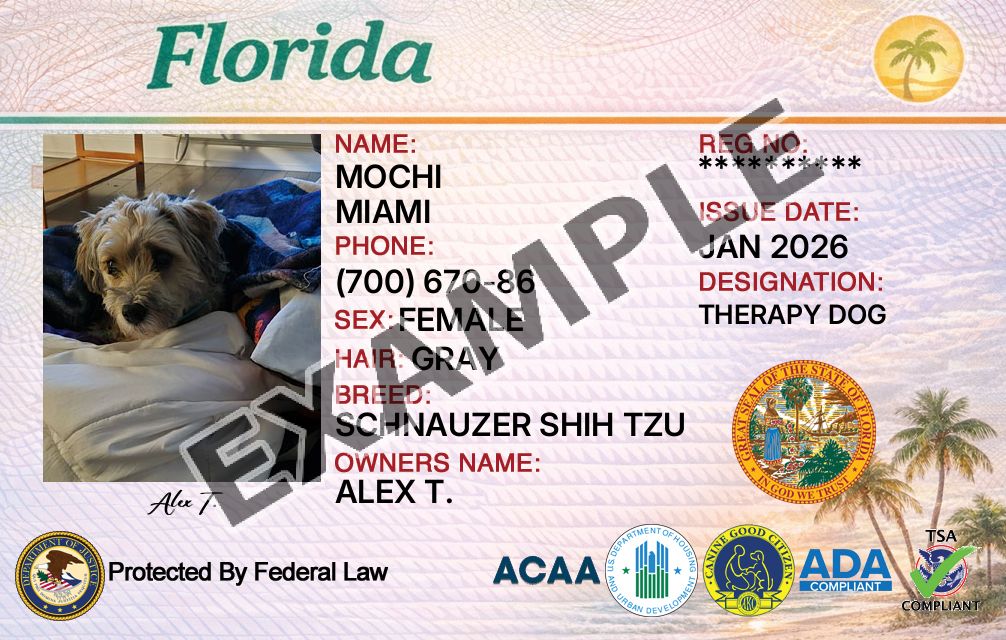
State Licensed, Service Dogs and Emotional Support Dogs in Florida
If you’re searching where do i register my dog in Miami, Florida for my service dog or emotional support dog, the most important thing to know is that “registration” can mean different things. In Miami, the practical, enforceable requirement is usually a local dog license (rabies tag) issued through local government (typically the county) and tied to a current rabies vaccination. Service dogs and emotional support animals (ESAs) are not “licensed” the same way—those terms relate to disability laws and housing rules, not a universal government-issued ID card.
This page explains where to register a dog in Miami, Florida for local licensing purposes, how animal control dog license Miami enforcement commonly works, what rabies documentation you’ll need, and how the rules differ for service dogs versus emotional support animals.
- Dog license in Miami, Florida usually refers to a local rabies/license tag requirement enforced by local animal services.
- Service dog status is created by what the dog does (trained tasks for a disability), not by buying a “registration.”
- Emotional support animals may be recognized for certain housing situations, but an ESA is not a service dog and does not automatically get public-access rights.
Where to Register or License Your Dog in Miami, Florida
Licensing is often handled at the county level in Florida. In Miami, the most common official starting point is Miami-Dade County Animal Services, which is responsible for animal services and animal control functions across much of the area. Some cities also route animal control calls through city channels (such as 311) while enforcement may still involve county animal services.
Miami-Dade County Animal Services (Pet Adoption & Protection Center)
Use this office as a primary point of contact for county animal services, licensing/rabies tag questions, and general guidance on compliance if you live in Miami-Dade County.
Miami-Dade County Animal Services (Administrative Contact Listing)
If you’re trying to reach the department and need an official email contact, this listing provides a county email address and phone number. (If you need in-person service, confirm which physical location handles licensing before visiting.)
City of Miami (Service Request / City Help Line)
City channels can help route you to the right place, especially if you’re unsure whether your address is served directly by county animal services or handled through a city process that coordinates with the county.
Overview of Dog Licensing in Miami, Florida
What “dog licensing” typically means
In much of Florida, “licensing” is closely tied to rabies control. A dog license commonly means a local license/rabies registration tag that shows your dog’s rabies vaccination is current and that your dog is registered within the local jurisdiction. This is the “official” requirement that animal control officers can enforce (for example, if your dog is found at large, involved in a bite incident, or when proof of rabies vaccination is requested).
Who issues the license in the Miami area?
Most licensing is handled locally—often at the county level. In the Miami area, Miami-Dade County Animal Services is a common licensing authority and is also associated with animal control enforcement functions countywide. Some cities provide additional local guidance and may direct residents to county services for licensing and rabies compliance.
How this connects to your service dog or ESA
Even if your dog is a legitimate service dog or an emotional support animal, you may still need to maintain a current local license/rabies tag. A service dog is not exempt from public health rabies rules, and an ESA is still a pet under most public-access laws. In other words, a dog’s working role does not replace the need for a dog license in Miami, Florida when local rules require it.
How Dog Licensing Works Locally in Miami, Florida
Step 1: Get a rabies vaccination from a licensed veterinarian
Florida law requires dogs (and certain other pets) to be vaccinated against rabies once they reach the required age threshold. In general, rabies vaccination is required for dogs 4 months of age or older, administered by a licensed veterinarian, with limited medical exemptions documented by a veterinarian.
Step 2: Keep proof of vaccination (certificate) and tag information
After vaccination, you should receive a rabies vaccination certificate from your veterinarian. This is often the key document used for licensing. Keep a copy you can present if requested by animal control, housing providers (where applicable), or facilities that require proof of vaccination.
Step 3: Obtain the local license/rabies tag (where offered)
In many Florida counties, dog licenses (rabies tags) can be obtained through animal services and sometimes through participating veterinarians (depending on local programs). In Miami-Dade, county animal services is a primary official resource for license and rabies-tag compliance questions. If your vet offers licensing/tag issuance, ask whether it is the official county tag and whether any additional steps are required.
Step 4: Renew on time and update your records
Licensing and rabies compliance are not one-and-done. Most dogs need periodic rabies boosters as determined by veterinary guidelines and applicable law, and local licensing/tag programs typically require renewal. If you move within Miami-Dade, change ownership, or change your contact information, update your records to reduce problems if your dog is ever lost and found.
Rabies vaccination requirements (why they matter)
Rabies is a serious public health issue. Local agencies may require proof of current rabies vaccination and may enforce licensing rules as part of bite investigations, loose-dog calls, and community safety enforcement. If you’re trying to figure out where to register a dog in Miami, Florida, the practical answer is: start with rabies vaccination proof and then register/license through the local animal services process.
Service Dog Laws in Miami, Florida
What makes a dog a service dog?
A service dog is generally a dog that is individually trained to do specific work or perform tasks for a person with a disability. The tasks must be directly related to the person’s disability (for example, guiding someone who is blind, alerting to a medical condition, retrieving items, interrupting self-harm behaviors, or providing mobility support).
Do you “register” a service dog with the government in Miami?
Typically, there is no single, universal government “service dog registration” that you must (or can) complete to make a dog a service dog. Be cautious of anyone selling IDs or certificates as if they create legal status. A service dog’s legal status comes from training and function under applicable disability laws—not from buying paperwork.
How local licensing interacts with service dogs
Even when a dog is a service dog, local public health and animal control rules can still apply—especially rabies vaccination and any locally required licensing/tag rules. So if your goal is compliance in Miami, you should handle both: (1) the dog’s training/role as a service animal and (2) the standard local requirements for a dog license in Miami, Florida.
Emotional Support Animal Rules in Miami, Florida
What is an emotional support animal (ESA)?
An ESA is an animal that provides comfort or emotional support that helps alleviate one or more symptoms or effects of a person’s disability. Unlike service dogs, ESAs are not required to have specialized task training.
ESA vs. service dog (public access vs. housing)
ESAs are often discussed in the context of housing rules. In general, ESAs do not automatically have the same public-access rights as service dogs (for example, in restaurants or stores). If you’re trying to “register” your dog as an ESA for Miami housing, the key is usually proper documentation through the appropriate channels—not a purchased registry.
Do ESAs still need local licensing and rabies compliance?
Yes. An ESA is still an animal subject to public health requirements. If Miami-Dade requires a license/rabies tag, an ESA is not automatically exempt. If you’re asking where do i register my dog in Miami, Florida for my service dog or emotional support dog, the local licensing piece generally follows the same path: rabies vaccination first, then the local licensing/tag process through official local animal services channels.
Frequently Asked Questions
Disclaimer
Local laws, office locations, and contact details may change. Residents should verify the most current information with their local animal services office in Miami, Florida.
Register A Dog In Other Miami Counties
Select your county from the dropdown below to get started with your dog’s ID card. Requirements and license designs may vary by county, so choose your location to see the correct options and complete your pup’s registration.
- Alachua County Dog Registration
- Baker County Dog Registration
- Bay County Dog Registration
- Bradford County Dog Registration
- Brevard County Dog Registration
- Broward County Dog Registration
- Calhoun County Dog Registration
- Charlotte County Dog Registration
- Citrus County Dog Registration
- City of Jacksonville County Dog Registration
- Clay County Dog Registration
- Collier County Dog Registration
- Columbia County Dog Registration
- DeSoto County Dog Registration
- Dixie County Dog Registration
- Duval County Dog Registration
- Escambia County Dog Registration
- Flagler County Dog Registration
- Franklin County Dog Registration
- Gadsden County Dog Registration
- Gilchrist County Dog Registration
- Glades County Dog Registration
- Gulf County Dog Registration
- Hamilton County Dog Registration
- Hardee County Dog Registration
- Hendry County Dog Registration
- Hernando County Dog Registration
- Highlands County Dog Registration
- Hillsborough County Dog Registration
- Holmes County Dog Registration
- Indian River County Dog Registration
- Jackson County Dog Registration
- Jefferson County Dog Registration
- Lafayette County Dog Registration
- Lake County Dog Registration
- Lee County Dog Registration
- Leon County Dog Registration
- Levy County Dog Registration
- Liberty County Dog Registration
- Madison County Dog Registration
- Manatee County Dog Registration
- Marion County Dog Registration
- Martin County Dog Registration
- Miami-Dade County Dog Registration
- Monroe County Dog Registration
- Nassau County Dog Registration
- Okaloosa County Dog Registration
- Okeechobee County Dog Registration
- Orange County Dog Registration
- Osecola County Dog Registration
- Palm Beach County Dog Registration
- Pasco County Dog Registration
- Pinellas County Dog Registration
- Polk County Dog Registration
- Putnam County Dog Registration
- Santa Rosa County Dog Registration
- Sarasota County Dog Registration
- Seminole County Dog Registration
- St. Johns County Dog Registration
- St. Lucie County Dog Registration
- Sumter County Dog Registration
- Suwannee County Dog Registration
- Taylor County Dog Registration
- Union County Dog Registration
- Volusia County Dog Registration
- Wakulla County Dog Registration
- Walton County Dog Registration
- Washington County Dog Registration